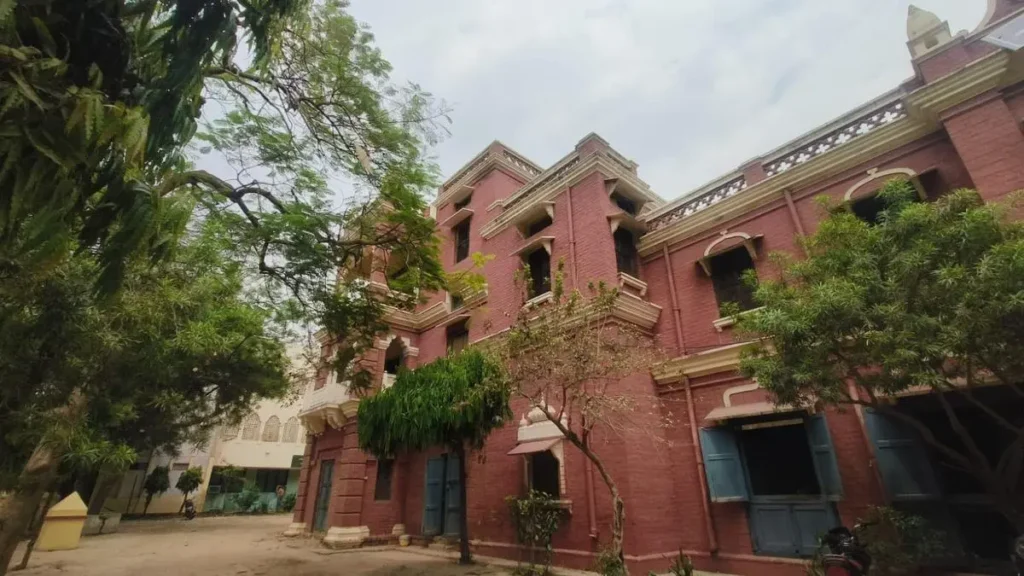
In the Vishweshwar Ganj of Banaras, directly across from the Head Post Office, stands a red building, made of bricks. It’s weather-worn, peeling at the edges. Created in the Indo-Saracenic style, it looks like a structure built with purpose. And now, it stands waiting.
This is the Nagari Pracharini Sabha, the house of Hindi, in Banaras.
The idea was born in 1893, masterminded by three students of Queen’s College: Shyamsundar Das, Ramnarayan Mishra, Shivkumar Singh. Perhaps one afternoon, in a modest room, they understood something simple yet radical: that one cannot merely love a language. One must shelter it. And so, they brought the Sabha into being.
It was a time when the country belonged to the British. Courts spoke in Urdu-Persian. Power was encoded in English. And Hindi? It was barely known, even less understood. Its script, Devanagari, emerged from village inkpots. Some called it sentimental. Others found it too soft, too domestic, unsuited for the iron cabinets of bureaucracy.
But those three young men, and later, many others, saw something different in Hindi. In its fragility, they saw truth. In its incompleteness, they saw possibility. They felt this language came from the earth, from wells, from wounds, from songs. That it was like an old tale each generation must retell, not to remember, but to belong.

Pradhan Mantri of the Nagari Pracharini Sabha, Vyomesh Shukla, in his office inside the renovated Nagari Pracharini Sabha. | Photo Credit: Vinayak
In 1900, the Sabha started publishing Saraswati, the first monthly literary magazine in Modern standard Hindi. Shyamsundar Das later gifted the language its dictionary, Hindi Shabdasagar, the ocean of words.
Their advocacy worked. After petitions and protests, the British Raj reluctantly allowed Hindi and the Devanagari script to be used officially. The movement spread across northern India, from Allahabad to Agra, from Lucknow to Delhi.
Repository of meanings
The Sabha had another dream. It founded the historic Arya Bhasha Library, where thousands of manuscripts and rare books were gathered. In 1930, the Bharat Kala Bhavan of Banaras Hindu University was also established under the Sabha’s stewardship. Here, painting, sculpture, textiles, forgotten gods, women of unnamed villages, all found a place where the past could converse with the present. And with this, the Sabha opened two more branches, one in Delhi and the other in Haridwar, ensuring that this movement did not remain confined to a single city.
“This place,” said poet and cultural theorist Vyomesh Shukla, who is the present Pradhan Mantri of the Nagari Pracharini Sabha, “was never just a building made of bricks and stones. It was a repository of meanings, ideas, and memories. When you entered, you stepped out not just with knowledge, but also with a new understanding of your roots and identity.”

Shukla interacts with visitors in Nagari Pracharini Sabha. | Photo Credit: Tapas
But as the decades passed, the Sabha began to fade. Papers piled up, unread. Dust settled over forgotten ideas. The walls of the library grew damp. Manuscripts, once written in golden ink, now lay scattered in disorganised piles of brittle leaves. No one had time for them anymore.
For years, the institution functioned without elections. Financial irregularities cracked its soul. Thenin 2022, under the supervision of the Allahabad High Court, an election took place, and the leadership of the Sabha changed. Vyomesh Shukla became the Pradhan Mantri of the Sabha. Along with Adhyaksh, Prof. Anuradha Banerjee, he launched a campaign of renewal.
“The first thing we had to fix was the silence,” said Shukla. It was the silence born of neglect and apathy, which had to be broken to create a new beginning for thought and dialogue. A list of books was compiled for the library. Manuscripts were digitised. The premises were cleaned.
Shukla explained, “Rebuilding the Sabha is not just about reprinting old books. It’s about preserving the roots, digitising rare manuscripts so that they can survive and speak to the future.”
Place of understanding Hindi
Plans are also underway to construct a modern auditorium and guesthouse within the Sabha complex. These new facilities will host literary workshops, residencies for young writers, and cultural programmes, to revive its once-vibrant role in Hindi intellectual life. “We do not want the Sabha to remain just a relic of the past,” said Shukla. “We want it to become a centre of dialogue.”
Poet and thinker Ashok Vajpeyi said, “The Nagari Pracharini Sabha is not just a museum of books; it is a place where the vision, understanding, and lived experience of Hindi takes shape.”

Cover of Hindi Sahitya Ka Itihas by Ramchandra Shukla. | Photo Credit: By Special Arrangement
Scholar Purushottam Agrawal echoed him, “The Sabha was not just a literary space; it was political too. It created a tradition.” For Agrawal, the Sabha is a movement, one that gave Hindi a voice of pride and self-respect.
Shukla said, “In recent years, the Sabha has played a vital role in reviving and preserving the priceless treasures of Hindi literature,” pointing to the republication of Acharya Ramchandra Shukla’s Hindi Sahitya Ka Itihas as a milestone in this process. More essential works are being prepared for reprint. One of the Sabha’s most lasting contributions is to the Hindi lexicon itself. Words such as Pradhan Mantri (Prime Minister), Samvidhan (Constitution), Sansad (Parliament), and Paryavaran (Environment) all trace their origin to the Sabha. It was also within the Sabha’s walls that the first published edition of Tulsidas’s Ramcharitmanas emerged, long before it became a household text through Gita Press.
Those who work here now—librarians, proofreaders, bookbinders, manuscript caretakers, and interns—are keeping alive what is not visible yet holds so much. In the Nagari Pracharini Sabha, words are once again coming to life. As Shukla said, “This building has started speaking again.”
Ashutosh Kumar Thakur is a management professional, literary critic and curator based in Bengaluru.